Image
The B.S. degree program in Environmental Engineering is accredited by the Engineering Accreditation Commission of ABET, under the commission’s General Criteria and Program Criteria for Environmental Engineering.

The overarching mission of the program is to prepare engineers who specialize in environmental systems at the baccalaureate level and understand how to apply engineering principles to solve environmental problems and harness energy while maintaining the integrity of the ecosystem. ENE Program identified five specific Program Educational Objectives (PEOs) to address the local, state, and national opportunities and needs. The ENE program expects the graduates within a few years of graduation to attain the following:
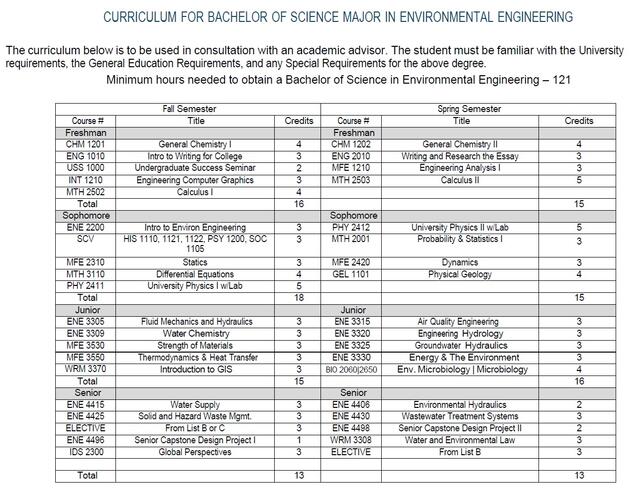
The curriculum relies on a strong foundation in sciences and mathematics by requiring students to take courses in rigorous college physics (calculus-based), chemistry and mathematics to advanced levels of differential equations and linear algebra. The program also promotes holistic development of students through courses in humanities, and in social and behavioral sciences as required in the general education curriculum.
Students take general engineering courses such as Engineering Computer Graphics, Statics, Dynamics, Strength of Materials, and other courses from the manufacturing engineering program (MFE). With this set of basic science and engineering courses, the program then provides a background in Applied Hydraulics, Wastewater Treatment Systems, Municipal and Hazardous Waste Management, Air Quality Engineering, and other engineering-based courses. There is an internship requirement, and students complete a capstone project in their final year. The Mc Lin Center, which houses the WRM Department, has excellent laboratory equipment in the areas of hydraulics, hydrology, water quality, and soils that is essential for the study of environmental engineering.
The department includes faculty specialized in air quality engineering, hydraulics, hydrology, solid waste management, water quality, water policy and regulations, economics, geography, and geology. The uniqueness of the Environmental Engineering (ENE) program at CSU is the availability of interdisciplinary courses within Water Resources Management (WRM). These courses cover critical issues in water, including policy, socio-economic impacts, environmental regulations, and GIS. The program directly serves the university's land-grant mission by preparing students for careers in civil engineering, environmental engineering, and hydrology in Agriculture, both in the public and private sectors. Environmental Engineering majors can pursue minors in nuclear engineering or in other approved programs.
To achieve the program's educational objectives, the environmental engineering program at CSU has adopted the following seven ABET student outcomes:
The environmental engineering curriculum provides students with the following competencies upon successful completion of the program:
A total of 121 semester hours are required for the B.S. degree in environmental engineering with a grade-point average of at least 2.0 in the major concentration.
In concert with the mission of the University, Environmental Engineering faculty foster the professional development of students through academic excellence, and provide educational opportunities to students to be competitive in a technological society.
First time students
Undeclared to STEM
Transfer Students
2+2 Transfer Students
Graduate to Industry
Graduate Schools
Year 4+
ENE 2200. Introduction to Environmental Engineering (I; 3) An introductory course that gives students some basic understanding of stoichiometry, chemical equilibrium, mass balances and kinetics (chemical and biological) in continuous and batch unit operations pertaining to environmental systems. Characterization of pollution in open systems such as streams, lakes and soil will be covered. Applications include drinking water, wastewater, municipal and industrial landfills, and hazardous waste operations. Site characteristics, risk analysis and assessment, toxicology, and site remediation will be briefly addressed. Students will work on generating an environmental impact statement for a construction project. Prerequisites: CHM 1201, MTH 2503.
ENE 3305. Fluid Mechanics and Hydraulics (I; 3) First course that deals with statics and dynamics of incompressible fluids in general, and water in particular. Fluid properties; Principles of hydrostatics; Kinematics and dynamics of fluid flows; Flow visualization; Mass, momentum, and energy conservation; Bernoulli’s principle; Introduction to fluid flow in closed conduits and open channels; Introduction to turbo machinery - pumps and turbines. Laboratory work includes demonstration of Bernoulli’s principle and Reynolds laminar and turbulent flow concepts; estimating pipe friction; energy principles in open channel flow and steady flow formulas - Chezy and Manning’s formulas; Hydraulic behavior of turbomachinery. Additional two contact hours are required for laboratory experiments. Three one hour lectures/one two-hour lab. Prerequisites: MTH 2503 and PHY 2411. Equivalent to OET009.
ENE 3309. Water Chemistry (I; 3) This is an applied course in chemistry dealing with chemical reactions in water. Chemical equilibrium speciation studies - Aqueous speciation, Precipitation-Dissolution, Oxidation Reduction in both natural and impaired aqueous environments. Rate laws and kinetics of aquatic reactions of environmental importance – Hardness Removal, Acid mine drainage, Disinfection. Laboratory experiments include estimation of total metals using atomic absorption spectrometer, organics using HPLC and Gas chromatograph/Mass spectrometer using EPA approved methods. Estimation of pH, dissolved oxygen, and conductivity. Colorimetric methods for estimation of chloride, nitrite, and nitrates in water. Use of a water chemistry model, MINTEQA2 to estimate species concentrations given the total metal, pH, and redox conditions. Two additional contact hours for the laboratory is required. Three one-hour lecture/one two-hour lab. Prerequisite: CHM 1202.
ENE 3315. Fundamentals of Air Quality Engineering (II; 3) Characterization and control of air pollution problems. Analysis of fundamental chemical and physical processes governing pollutant transport and dispersion in air. Combustion chemistry of hydrocarbon fuels. Air pollution control systems. Pollution sources, control techniques with introduction to sensors. Transformations, atmospheric transport, deposition and modeling. Indoor Air quality management. Three one-hour lecture.
ENE 3320. Engineering Hydrology (I; 3) Physical hydrology phases hydrologic cycle evaporation, precipitation, infiltration and runoff. Physical and empirical models of evaporation from water bodies, evapotranspiration models; Precipitation measurement and assessment of temporal and spatial variability; Infiltration theory and modeling; rainfall runoff correlation in watersheds - overland flow, hydrographs and flow routing; Empirical models of rainfall-runoff correlation; statistical hydrology concepts; Environmental Hydrology. Three one hour lecture/one two-hour lab. Prerequisites: ENE 3305 and MTH 2001.
ENE 3325. Groundwater Hydraulics (II; 3) Study of aquifers and their characteristics- porosity, specific yield and specific retention, permeability and transmissivity. Darcy’s law and fluid continuum in soils; steady flow through confined/ unconfined/artesian aquifers with and without recharge; hydraulics of wells in confined and unconfined aquifers; design of wells; estimating groundwater characteristics using pumping data; groundwater contamination - site assessment, geologic study, plume delineation and remedial action. Introduction to groundwater flow models using MODFLOW; Well-head protection. Three one-hour lecture/one two-hour lab. Prerequisites: ENE 3305, and GEL 1101 or instructor’s permission.
ENE 3330. Energy and The Environment (II; 3) This course explores current and emerging topics in sustainable energy development. The primary focus will be on interconnectedness between energy development and environmental degradation with a goal to sustaining natural ecosystems. Discussion of all forms of energy production, consumption by different sectors, and environmental impacts and mitigation. Emphasis will be on clean and renewable energies as solutions to addressing climate change. The course introduces materials for energy, energy calculations through application of thermodynamic/mass and heat transfer principles and explores basic design principles behind energy conversions, power calculations and efficiencies. Includes domestic examples and global case studies. Field trip to a local energy facility. Prerequisites: ENE 2200, CHM 1202, PHY 2412.
ENE 4406. Environmental Hydraulics (II; 2) Two hour Lecture Application of hydraulics for environmental engineering systems in aspects of design with emphasis on cost optimality, energy conservation and sustainability. Hydraulic flows in treatment systems, distribution networks, riverine and reservoir regulation systems, water conducting systems for water supply and water power, measurement structures and flow through pumps and turbines. The hydraulic demonstration will emphasize learning the impact of different parameters for design and operate in hydraulic flows in environmental engineering systems. Prerequisites: ENE 3305.
ENE 4415. Water Supply (I; 3) The course will focus on the design and operation of water supply facilities collection, treatment, and distribution. US EPA regulations on water quality, water quality standards, clean water act; water abstraction systems; theory and design of physical and chemical treatment systems-screening, sedimentation, coagulation, filtration, softening and disinfection. Water distribution pipe networks; laboratory experiments include jar testing for coagulants, and also an analysis of trihalomethanes. Three one-hour lecture/one two-hour for laboratory work and design calculations. Field trip to a local water treatment plant. Prerequisites: ENE 3309, BIO 2060/BIO 2650.
ENE 4425. Solid and Hazardous Waste Management (II; 3) Municipal solid waste topics include history, regulations, sources, composition, properties, engineering principles in handling, transferring and transporting, material separation, processing technologies, recycling, thermal conversions, design of incinerators, biological and chemical conversions, and remediation. Topics related to hazardous waste including identification, segregation, labeling, storing, disposal and clean up, and related hazardous waste regulations. Three one-hour lecture classes. Prerequisite: CHM 1202.
ENE 4430. Wastewater Treatment Systems (II; 3) A process design approach to studying wastewater treatment systems. Study of wastewater flows- quantity and quality. Study of sewer system design and maintenance. Fundamentals of reactor design with illustrations from wastewater treatment systems. Theory and design of key unit operations in wastewater treatment plant. Primary treatment processes-grit settling chambers and Parshall flume design, mechanically agitated screens, primary clarifier and odor control unit; Secondary treatment suspended growth systems; activated sludge with various configurations on feed and oxygen introduction, and oxidation ditch; attached growth systems theory of biofilms, design of trickling filters and rotating biological contactors. Solids handling: sludge digester theory and design, sludge loading and dewatering, digester gas and cogeneration. Field trip to a wastewater treatment plant. Laboratory experiments include wastewater characterization and disinfection by-products identification using gas chromatograph/mass spectrometer. Three one-hour lecture/one two-hour for laboratory work and design calculations. Prerequisites: ENE 3309, BIO 2060/BIO 2650.
ENE 4496. Senior Capstone Design Project I (I; 1) The first part of a two-course sequence. It is designed for graduating seniors to integrate the knowledge they had gained in all ENE courses and apply it in a field application/capstone design project related to a topic of interest within the field. Each student/student team will be required to work on an engineering project, such as designing a typical environmental engineering system or recommending improvements in the operation of an environmental control system. Students will be expected to submit a formal report and an oral presentation to the environmental engineering professionals. This course involves selecting a topic and advisor(s), conducting a literature search, understanding codes and regulations, conceptual design, selecting design tools, plan of work, and securing necessary resources. Prerequisites: Senior standing in the ENE or the WRM major.
ENE 4498. Senior Capstone Design Project II (II; 2) The second part of a two- course sequence. It is designed for graduating seniors to integrate the knowledge they had gained in all ENE courses and apply it in a field application/capstone design project related to a topic of interest within the field. Each student /student team will be required to work on an engineering project such as designing a typical environmental engineering system or recommending improvements in the operation of an environmental control system. Students will be expected to submit a formal final report and an oral presentation to the Environmental Engineering Professionals. This course involves design implementation, evaluation of alternatives, economic analysis, and inclusion of public health, safety, and welfare aspects. Prerequisite: ENE 4496.
OTHER COURSES
ENE 4405. Applied Hydraulics (II; 3) Application of principles of fluid mechanics to flow in pipes, pipe networks, open channels and hydro-machinery. Estimation of pressure distribution in pipe networks; Design of pipe networks; friction loss computation using Darcy-Weisbach, Hazen-Williams and Manning equations, solutions to pipe network problems using Hardy-Cross method, and use of computer models for the hydraulic design of pipe networks. Nonuniform flow in open channels and its application to flooding in rivers; introduction to unsteady flow in pipes and open channels; dimensional analysis; hydraulics of pumps and turbines; and introduction to sediment transport in rivers. Prerequisite: ENE 3305.
ENE 4410. Water Model Applications (I; 4) This will be an applied course in the use of various water quality and water quantity models used in the water industry. The areas will cover hydrology, hydraulics, and groundwater and water quality. Emphasis on problem solving with real world conditions. Models considered include HEC-HMS and RAS, GMS, QUAL2EU, EPANET, WMS. Prerequisite: ENE 3325 or permission of the instructor.
ENE 4435. Soil and Water Pollution Control (II; 4) An advanced course that deals with physical and chemical characteristics of pollutants in soil and water and their fate and transport; thermodynamic properties of organic and inorganic pollutants in soil and water; equilibrium partitioning of pollutants in the environment; air to water partitioning using Henry’s Law; vapor pure liquid partitioning using Raoult’s Law; soil water partitioning using Freundlich, Langmuir and BET sorption isotherms; modeling fate and transport of pollutants in soil and water, non-aqueous phase liquids. Use of 1-D groundwater models such as CXTFIT; Groundwater contamination using CHEMFLO and MODFLOW; Overview of remedial technologies discussion on engineering controls such as pump and treat and soil washing, biological treatments such as bioremediation and phytoremediation; case study on non-point source pollution. Prerequisites: ENE 3309 and ENE 3325.
ENE 4440. Environmental Professionals Seminar (I, II; 1) Discussions led by working professionals in the field of Environmental Engineering on selected topics in the field. Designed to expose students to a wide range of practitioners and issues.
ENE 4497. Special Problems in Environmental Engineering (I, II, III; 3) Individual study in advanced water resources management research. Open only to juniors and seniors.
ENE 4596. Internship (I, II, III; 3) On the job training in agencies and/or companies engaged in activities related to environmental engineering/ water resources management. Not open to students who have participated in the co-op program.
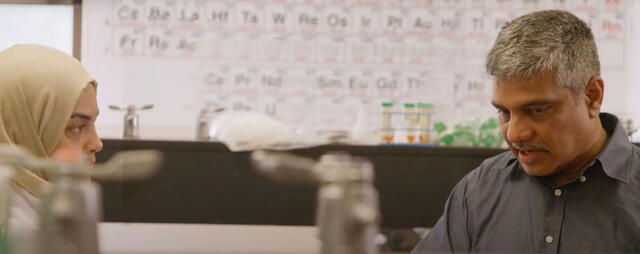
Environmental engineers apply the principles of engineering in practice using their knowledge in basic sciences and mathematics and socio-economics to develop solutions to environmental problems. Environmental engineering involves engineering better environments with preservation, prevention, control, remediation, and restoration of the earth.
Learning doesn’t stop when class ends. Opportunities to increase your knowledge and expand your network include hands-on research for all students, and top speakers from the field.
At CSU, even undergraduates do research, whether it’s at the campus lab or off-campus at an internship. You’ll work with professors and research scientists, and some students present and publish nationally.
You’ll hear about research, the bedrock of the field from guest speakers throughout the year. And you’ll begin to imagine the career paths you can take with your degree and the impact you’ll be able to have.
Students who qualify for induction have access to national speakers and networks in the discipline.