Image
The BS degree program in Manufacturing Engineering is accredited by the Engineering Accreditation Commission of ABET, under the commission’s General Criteria and Program Criteria for Manufacturing Engineering.

Manufacturing is one of the major wealth-producing sectors of the world economic structure with a direct and powerful impact on the quality of life of everyone. The field of manufacturing has undergone dramatic changes during the past decade. Diverse forces driving these changes include the following factors: rapid technological advances in areas such as computers, lasers, machine vision, robotics and automation; emerging new materials including polymers, composites and ceramics; an increasing global economy with intensified international trade competition; changing national defense and security priorities; changing labor management relationships; dwindling natural resources; increasing energy costs; bio-socio-educational factors impacting educational access and delivery and heightened environmental concerns.
These factors continue to produce new demands and exciting opportunities for manufacturing engineers. Graduates of the program have found diverse employment in manufacturing fields such as automotive, aerospace, electronics, defense, food processing, and consumer product industries. Graduates of the Manufacturing Engineering program are in great demand from prestigious firms and government agencies. Others have earned related graduate degrees at some of the nation’s finest graduate engineering schools prior to assuming industry positions.
The Manufacturing Engineering program at Central State University is dedicated to preparing students for manufacturing engineering careers in diverse manufacturing enterprises. The MFE Program expects the graduates within a few years of graduation to attain the following objectives:
The Bachelor of Science degree program in Manufacturing Engineering has been designed to address these objectives. The curriculum follows guidelines established by the Society of Manufacturing Engineers (SME), an international organization headquartered in Southfield, Michigan, with over 30,000 members in seventy-two (72) countries. SME seeks
to ensure that Manufacturing Engineering programs produce engineers prepared to address industry demands for increasingly sophisticated manufacturing technology, and ready to play an important role in planning, building, and optimizing the “factories of the future.” Emphasis is, therefore, given to computer-aided design and manufacturing
(CAD/CAM), layered manufacturing or 3-D printing, microprocessor control, manufacturing planning and control, quality and reliability assurance, metrology and the processing and utilization of engineering materials. The program provides opportunities for hands-on experience in the application of the knowledge embodied in these disciplines. The BS degree program in Manufacturing Engineering is one of only a few programs in the nation which are dedicated to undergraduate manufacturing engineering education, and which are accredited by the Engineering Accreditation Commission of the Accreditation Board for Engineering and Technology (EAC/ABET), http://www.abet.org .
The overarching goal of the program is to produce graduates who are well prepared to:
The overall Manufacturing Engineering curriculum consists of strong components of mathematics, basic sciences, engineering sciences, humanities, and social sciences, together with the major engineering requirements, which can be grouped into the following topic areas:
Materials and Manufacturing Processes — the structure and property relationships of materials and their change with materials processing.
Process, Assembly, and Product Engineering — the design of products and the equipment, tooling, and environment necessary for their manufacture, supported by rapid prototyping and 3-D layered manufacturing.
Manufacturing Competitiveness — the creation of competitive advantage through manufacturing planning, strategy, and control. Topics such as productivity, quality, reliability, economic and cost analysis, human resources, product safety and liability, social concerns, international issues, environmental impact, and product life cycle are included in this area.
Manufacturing Systems Design — the analysis, synthesis, and control of manufacturing operations emphasizing modern technologies and tooling and statistical and calculus-based methods.
Simulation and Information Technology — Simulation, modeling, control, architecture, and information systems supported by experimental design for factory optimality control are included in this area.
Laboratory Experience - Measuring manufacturing process variables in a manufacturing laboratory and making technical inferences about the process. Throughout the curriculum major emphasis is given to the engineering design function.
The Engineering Accreditation Commission of the Accreditation Board for Engineering and Technology (EAC/ABET) has published the following description for engineering design:
Engineering design is the process of devising a system, component, or process to meet desired needs. It is a decision-making process (often iterative), in which the basic sciences, mathematics, and engineering sciences are applied to convert resources optimally to meet a stated objective. Among the fundamental elements of the design process are the establishment of objectives and criteria, synthesis, analysis, construction, testing and evaluation. The engineering design component of a curriculum must include most of the following features: development of student creativity, use of open-ended problems, development and use of modern design theory and methodology, formulation of design problem statements and specifications, consideration of alternative solutions, feasibility considerations, production processes, concurrent engineering design, and detailed system descriptions. Further, it is essential to include a variety of realistic constraints, such as economic factors, safety, reliability, aesthetics, ethics and social impact.
In the senior year, the design experience culminated with a sequenced two-semester “capstone” design project. Students work on individual or team design projects under close faculty supervision. A broad range of resources, including machine tools, materials testing and processing equipment, electronic and measuring instrumentation, computers, and control devices, is available to prepare students for the real-world challenges of the engineering profession. Oral and written communication skills are emphasized in the senior design project.
The broad educational experience outlined above is designed to integrate the knowledge, skills, attitudes, and values acquired in a diverse set of courses to produce graduates with the following specific student outcomes:
First time students
Undeclared to STEM
Transfer Students
2+2 Transfer Students
Graduate to Industry
Graduate Schools
Year 4+
DEGREE REQUIREMENTS A total of 123 semester hours are required for the BS degree in manufacturing engineering:
GENERAL EDUCATION REQUIREMENTS (Min 39-40 hours): Twenty-seven of a total fifty (50) credits apply also to the manufacturing engineering (MFE) program requirements; see University General Education Requirements.
MANUFACTURING ENGINEERING PROGRAM REQUIREMENTS:
The majority of the MFE courses emphasize design, the process of devising a system, component, or process to meet some desired need. The design course work provides experience in open-ended problem solving by combining decision 186 making and creative thought with basic and engineering sciences. The design experience is incorporated across a variety of subject areas and increases in amount and complexity. In addition, the MFE Program is addressing the desired outcomes defined by the Society for Manufacturing Engineers (SME). It had put in place the mechanisms to ensure that by the time of graduation, the graduating seniors do possess:
BACHELOR OF SCIENCE IN MANUFACTURING ENGINEERING — Marauder Lifestyle Courses: USS 1000 and 1 semester credit from Physical Activity (List A); Marauder Foundation Core Courses: ENG 1100 or ENG 1101, MTH 2502, and HIS 1110, HIS 1121 or HIS 1122; Marauder Foundation Bridge Courses: ENG 1102, 3 hours from Humanities (List B); 6 hours in two disciplines from Social and Behavioral Sciences (List C); CHM 1201, CHM 1202, PHY 2411, PHY 2412, MTH 2503, and MTH 3110.
All manufacturing engineering majors must take the following major requirements: INT 1210, MFE 1110, MFE 1210, MFE 2310, MFE 2320, MFE 2410, MFE 2420, MFE 2430, MFE 2440, MFE 3510, MFE 3520, MFE 3530, MFE 3540, MFE 3550, MFE 3610, MFE 3620, MFE 3630, MFE 3640, MFE 4710, MFE 4720, MFE 4730, MFE 4795, MFE 4810, MFE 4820, MFE 4895. A grade of “C” or better in these courses is required to earn a major degree in Manufacturing Engineering.
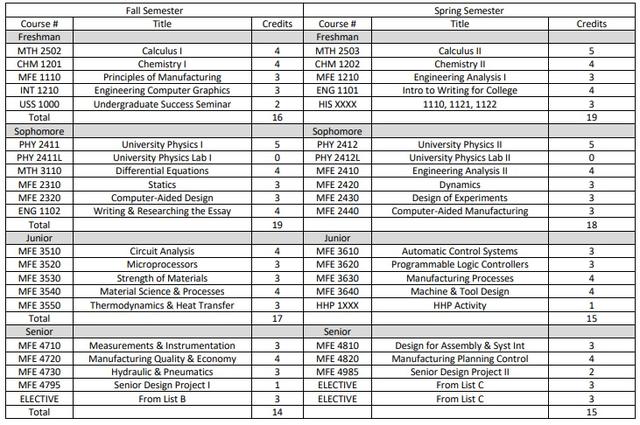
SUGGESTED CURRICULUM FOR THE DEGREE, BACHELOR OF SCIENCE MAJOR IN MANUFACTURING ENGINEERING The curriculum below is to be used in consultation with an academic advisor. The student must be familiar with the University requirements, the General Education Requirements, and any Special Requirements for the above degree.
Minimum hours needed to obtain a Bachelor of Science in Manufacturing Engineering – 123