Image
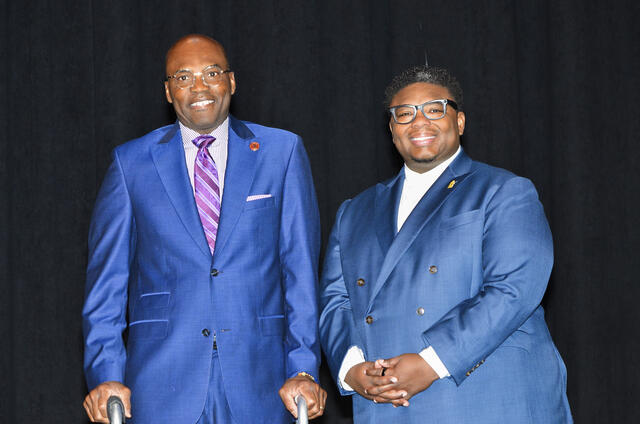

Ohio lawmaker discusses proposed Celebrate HBCU Month, Central State’s resilience and the responsibility of carrying forward an ‘inheritance of possibility’
For Ohio state Rep. Dontavius L. Jarrells, recognizing historically Black colleges and universities is about more than setting aside time on the calendar. It is about ensuring their history, contributions and future are permanently recognized in the story of Ohio.
During a recent visit to Central State University, Jarrells discussed House Bill 848 of the 136th Ohio General Assembly, legislation he introduced with state Rep. Andrea White to designate September as “Celebrate HBCU Month” in Ohio.
The bill would enact Section 5.2325 of the Ohio Revised Code, formally establishing the annual designation. For Jarrells, the legislation addresses what he sees as a missing piece in Ohio’s formal recognition of institutions that have educated generations of students and produced leaders serving communities throughout the state.
“There’s nothing specific in our Ohio Revised Code that says we even honor HBCUs,” Jarrells said. “There are a number of HBCU alumni that work, play and live in Ohio. And I wanted to just create a month where we are really being intentional about the value of HBCUs in the lifeblood of Ohio.”
“This bill really is just a love letter, if you will, to our HBCUs to say we see you, recognize you and we want you to stay.”
HB 848 was introduced May 6 and referred to the House Workforce and Higher Education Committee on May 13. Jarrells and White are the bill’s primary sponsors. The committee held its first hearing June 3, followed by a second hearing June 8 that included testimony connected to Central State University.
Jarrells said putting the designation into state law would give the recognition a permanence that individual events or proclamations cannot necessarily provide.
“The full designation, it lasts a lifetime,” Jarrells said. “Oftentimes, if you don’t have it written down, did it exist?”
He said establishing the month would place “a stamp on the history of Ohio” and create an annual opportunity for communities to celebrate and honor the people, culture and institutions that make up the HBCU community.
Jarrells said he also views the proposed designation through the broader lens of Black history and the generations that built institutions such as Central State during a period when educational opportunities for Black Americans were severely restricted.
“We all stand on the shoulders of ancestors who never thought what was possible today,” he said. “I want to see HBCUs thrive, not just in Ohio, but I really want the state of Ohio to be an example or a case study of what is possible across our nation when we say that we uplift, we invest and we make sure that our HBCUs thrive.”
The conversation took on particular significance at Central State, Ohio’s only public HBCU and an 1890 Land-Grant Institution. The university traces its history to 1887 and received its 1890 Land-Grant designation in 2014.
Jarrells pointed to one word when discussing that history: resilience.
Central State has endured periods of financial difficulty and the devastating 1974 tornado that struck Wilberforce, among other challenges. To Jarrells, the university’s ability to continue its mission illustrates a larger story of perseverance.
“Central State University has fallen and got up, brushed itself off — the tornado, the financial issues, I mean, you name it,” Jarrells said. “When I think about the resilience of Central State and other institutions like Central State University, it shows what I think is just the plight of America, particularly Black America, that we have to constantly get up, dust our shoulders off and say that we’re going to exist and persist.”
Jarrells said his role as a legislator is to help remove barriers through legislation, public investment and advocacy.
“My job, I believe as a legislator, is to make life easier for people through the laws that I pass, the money I invest in and the people I uplift,” he said.
For Jarrells, strengthening HBCUs is part of that work.
“If we all do just one thing and do it well, how far we all will come in terms of building that resilience into resistance and ultimately into existence,” he said.
Jarrells’ visit to Central State extended beyond a discussion of legislation. During the university’s Convocation Speaker Series, he challenged students to consider what they have inherited from the generations that came before them — and what they will do with it.
He described that inheritance not simply in terms of history but as possibility.
“We are all inheriting possibility from somebody who prayed for us to get here, who sacrificed for us to get here, who showed us the way,” Jarrells said.
For the students listening, Jarrells said attending an HBCU places them within a continuum built by people who imagined opportunities they might never experience themselves.
“You are standing on the shoulders of people that saw your potential before you even saw it yourself,” he said. “The choice that you have in front of you now is to take that possibility and make it real.”
Jarrells acknowledged that the path ahead would not always be easy. He encouraged students to draw from the same resilience that has sustained institutions such as Central State and the generations that preceded them.
“You get to make that real for somebody,” Jarrells said. “So make it real for yourself.”
He added that students today have an opportunity to build lives that previous generations may never have imagined possible.
Beyond recognition, Jarrells said he wants Celebrate HBCU Month to create tangible opportunities for prospective students.
His vision includes HBCU-focused programs, scholarships, college visits and partnerships that introduce students across Ohio to historically Black institutions.
Jarrells said those opportunities should reach students regardless of whether they attend public, private or charter schools or live in rural, suburban or urban communities.
“They should be presented with every opportunity and option available to them, including HBCUs, to make the best decision for their life,” he said.
Jarrells said some Black students in Ohio may not consider an HBCU simply because they have had little exposure to the institutions. An annual statewide celebration, he said, could help change that.
“I want to change that paradigm so that when you think about choosing a school, you have the full deck of cards in front of you to make the best decision for you,” he said.
That goal also shapes how Jarrells said he would ultimately measure the legislation’s impact.
“If a student decides to go to Central State University, or any HBCU for that matter, because a program was developed, a scholarship was formed and a trip was planned from their school or otherwise, the bill did its job,” Jarrells said.
For Central State, Jarrells said the conversation surrounding HB 848 underscores the university’s distinct role in Ohio.
Central State is the state’s only public HBCU and an 1890 Land-Grant Institution, a designation that supports its teaching, research and Extension mission in areas including agriculture, science, technology and engineering.
Asked what Central State’s presence means to Ohio, Jarrells did not hesitate.
“Oh my gosh, it means everything,” he said. “It’s the reason why we are fighting so hard to make sure that Central State University exists and thrives, not just survives.”
Jarrells said the legislative process surrounding HB 848 has also demonstrated the depth of support for Central State across political lines.
“When we introduced the bill and we had our various testimonies and committee hearings on the bill, there was not a Republican or Democrat who did not believe in the vibrancy that is Central State University,” Jarrells said. “Every single member came up to me after session or after a committee and was like, ‘Hey, I love this bill. I love Central State University. I love the importance of it.’”
For Jarrells, those conversations demonstrated that Central State’s significance extends far beyond its campus.
“It just showed me that the history and the community and the connection to Central State University runs really deep in the state of Ohio amongst all of us,” he said.
That connection, Jarrells said, makes ensuring the university’s long-term success especially important.
“I want to make sure that in the eons of history that is to come, this institution is a thriving beacon of possibility,” Jarrells said. “That’s what I will say is at the bedrock of why everyone is so excited to support Central State University, because we know how important it is for this institution to exist.”
His hope is that generations from now, the impact of Celebrate HBCU Month will be measured not simply by a designation in the Ohio Revised Code but by students whose lives were changed because they discovered opportunities at an HBCU.