Image
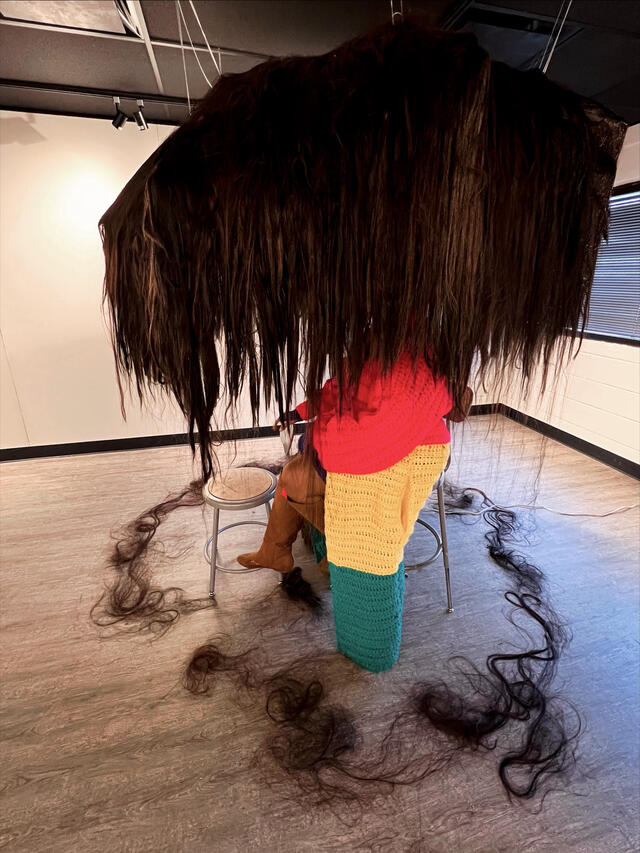
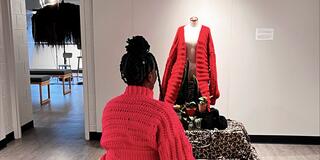
On Friday, November 14th, at the Charles White Gallery in the Paul Robeson Cultural & Performing Arts Center, Central State University was honored to feature Professor Erin Smith Glenn’s art exhibit, HAIRitage. Offering attendees a powerful, interdisciplinary exploration of ancestry, identity, and artistic innovation.
The exhibit blended traditional fine art with installation art and bio art — artwork that incorporates living organisms — transforming the gallery into an immersive learning space reflective of Smith’s teaching philosophy and creative vision.
An Interdisciplinary Approach to Art
Smith approaches art through multiple academic lenses, integrating science, psychology, mathematics and behavioral studies into both her classroom instruction and creative work.
“I talk about art through the scientific, the psychological and the natural sciences,” Smith said. “Sometimes we pull in math, especially when we’re dealing with perspective.”
Works within HAIRitage demonstrate that balance, pairing precise technical compositions rooted in Renaissance traditions with expressive, contemporary interpretations. Smith said being well-rounded in the art of perspective is an essential lesson that she pours into her students. “It’s important for them to understand both the expressive and the technical side” she said.
Signature Works Rooted in Ancestry
One of the exhibit’s most prominent pieces, Covered by My Ancestors, took approximately six weeks to complete and when fully expanded spans a large portion of the gallery space. The crocheted garment, designed entirely by Smith, is meant for display rather than wear. Smith said the piece was inspired during her sabbatical and reflects her commitment to creating what cannot be found elsewhere.
“People get tired of walking into stores and not finding what they want,” she said. “So, people like me create what we can’t see.”
Another emotionally resonant installation, the “hair hut,” draws from Smith’s childhood spent in a Columbus hair salon — a community hub owned by a Black woman where women gathered, shared stories and supported one another.
“Artists visually showcase our life experiences,” Smith said. “This is about homage — the past meeting the present.”
Mental Health, Healing and Student Connection
In addition to ancestral storytelling, Smith’s work openly addresses mental health. Her ongoing series, From the Inside Out, focuses on healing the inner child, particularly within the Black community. Smith said sharing this work has strengthened her relationships with students, encouraging open conversations about anxiety, depression and well-being.
“Students feel more comfortable opening up,” she said. “Then we can talk, and I can recommend support resources.”
She frequently collaborates with campus counseling services and is planning hands-on art therapy projects with students in the coming year.
A Journey That Shapes Leadership
Smith’s mentorship is shaped by her own academic journey. While earning her Master of Fine Arts degree from the University of Cincinnati, she later learned she was the first Black woman in the institution’s history to do so — a milestone that was never disclosed to her at the time.
“That explained why it was so hard,” Smith said. “I was just so excited to be in graduate school because that was a dream of mine from high school, I thought if I could just get this bachelor's degree, then I can go to grad school. I was already seeing myself in grad school even before I came to Central”. Smith frequently gets invited back to her second alma mater at the University of Cincinnati.
Those experiences now inform her leadership at Central State, where she emphasizes resilience, representation and creative confidence.
Beyond the Campus Walls
While HAIRitage was deeply meaningful to present at Central State University, the exhibit’s impact is extending beyond campus. The show is scheduled to travel to a gallery outside of Cincinnati, bringing Smith’s work — and the stories embedded within it — to a wider audience. Still, Smith said getting to share her work with the campus held special significance.
“The students got to experience it,” she said. “That mattered to me.”
Leaving Blueprints for the Future
Smith said she accepts that not all of her ideas will manifest within one lifetime. Instead, she hopes to leave “blueprints” for future artists — particularly her students — to expand upon.
“A lot of artists’ students picked up where they left off,” she said. “I figure that’s how it’s supposed to be.”
For Smith, HAIRitage is both a personal triumph and a teaching tool — one that affirms art as a space for healing, history and transformation.