Image
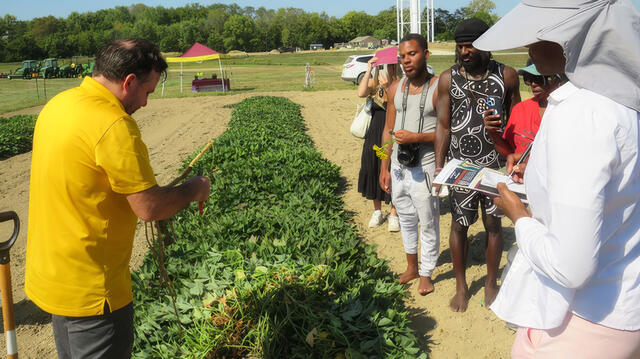
For nearly a decade, Marcus Nagle, Ph.D., research associate professor of horticulture at Central State University (CSU), has devoted his scholarly career to a mission he believes is essential to Ohio’s agricultural future: identifying alternative and perennial crops capable of thriving in the state’s climate and diversifying its farming economy.
“Ohio needs more options—more crops that work for farmers, more diversity in the field, and more ways to reduce agricultural risk,” he says. “Looking for these alternatives has become one of the major goals of the state and one of the focal points of our work here at Central State.”
Before joining CSU in 2017, Nagle earned his Ph.D. in agricultural sciences from the University of Hohenheim in Germany—one of Europe’s premier agricultural research institutions—where his work spanned fruit crops, grain crops such as rice, and tropical agriculture. That breadth now informs his approach to testing plant performance across varied environments in Ohio.
“Ohio needs more options—more crops that work for farmers, more diversity in the field, and more ways to reduce agricultural risk. Looking for these alternatives has become one of the major goals of the state and one of the focal points of our work here at Central State.”
One of Nagle’s longest-running projects adapts sweet potatoes—a tropical/subtropical crop—to the cooler, inconsistent warmth of the Midwest. The team evaluates experimental lines for traits that enable reliable yields despite shorter seasons and temperature swings, sourcing materials through collaboration with the USDA-ARS in Georgia. “Sweet potato likes warm conditions, which we don’t always have here,” he explains, “but there are varieties suited for colder climates. Our work is to test them and determine which ones can be viable options for farmers.”
The implications extend well beyond Ohio. Techniques and varieties that succeed here could help growers throughout the upper Midwest and New England—regions that face similar climate constraints—expand into a valuable specialty crop with strong consumer demand.
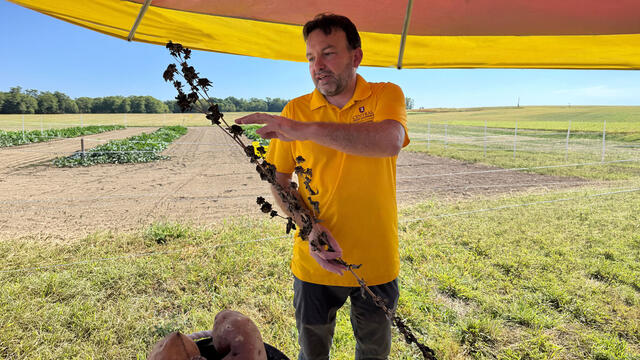
If alternative crops diversify income, perennial crops reshape sustainability. Perennial grains and oilseeds require a single planting, returning year after year to protect soil, reduce erosion, and support ecological stability. Nagle’s team is field-testing a perennial sunflower—a native Great Plains species and cousin of the familiar annual sunflower—for its agronomic and ecological potential in Ohio.
“It’s an ecosystem benefactor,” he notes. “It improves soil quality and supports pollinators while producing seeds farmers can use for oil.” With six test plots established in the region around CSU, the group is evaluating persistence, seed yield, and management practices that could make the crop farmer-friendly.
Those domestication efforts draw on a partnership with Salina, Kan.-based The Land Institute, whose long-term breeding programs aim to bring perennial staples into mainstream agriculture. The CSU trials are an Ohio-specific proving ground, assessing how perennial sunflower handles local soils, weather, and weeds—essential steps before broader adoption.
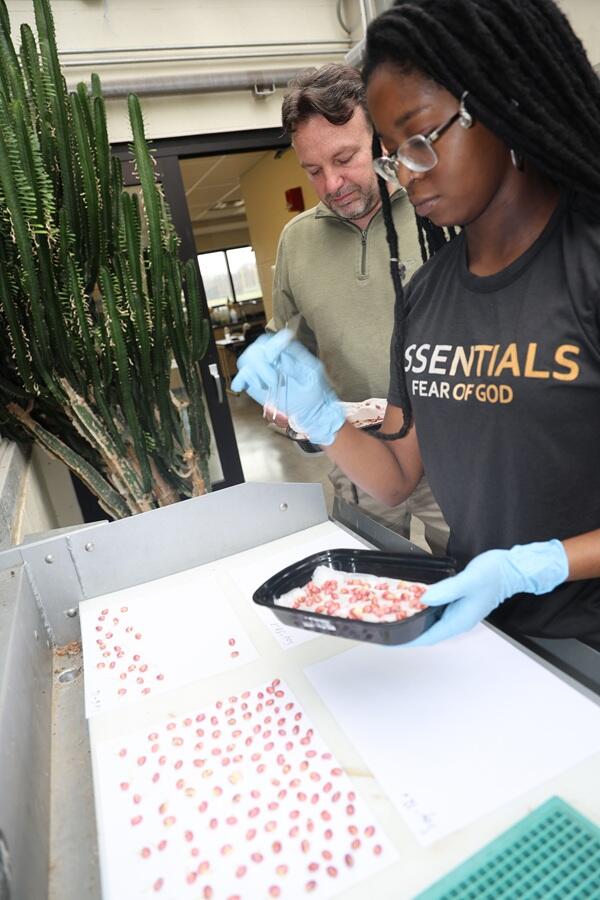
Given soybean’s status as a top Ohio commodity, Nagle is also exploring ways to enhance yield without adding chemical inputs. In collaboration with Xenia-based Global Neighbor, his team is testing “directed energy” treatments on seeds and seedlings to stimulate vigor and productivity—an approach he believes could be scaled to implements and tractors for field-level application. The aim is a technology that’s adoptable, economical, and environmentally responsible.
Dr. Nagle has “taught me literally anything and everything—from how to grow plants and take care of them to identifying diseases and pests.”
The laboratory and field plots are also a classroom—one that has shaped the aspirations of students like Meyah Pillow, a graduating senior in sustainable agriculture with a minor in water resource management. She says working with Nagle has “taught me literally anything and everything—from how to grow plants and take care of them to identifying diseases and pests.” Beyond the fundamentals, the lab experience gave her confidence as a researcher: “I’ve learned how to conduct research on my own and how to support someone else’s project.” While Pillow plans to go straight into the workforce rather than graduate school, she’s unequivocal about her path:
“I want to continue with research because I love plants—and I want to keep working with plants,” Pillow says.
As Pillow puts it, the experience “showed me I want to continue along the plant science path”—a statement that underscores CSU’s role in cultivating the next generation of agricultural professionals.
For Junior Pierre, a junior majoring in sustainable agriculture who grew up in the Bahamas, Nagle’s mentorship is both personal and transformational. “The most exciting thing is learning new ways to grow plants—to be more sustainable,” he says, noting that his dream is to return home and help produce more food not just for the Bahamas but for as many people as possible. “To do that, I need to learn as much as I can.”
Pierre recalls arriving in the U.S. and feeling out of place—spending lots of time alone in his dorm room and unsure how to start. The lab changed that. “Dr. Nagle motivates me,” he says. Seeing the team’s confidence with challenging projects—like coaxing strong yields from cool-climate sweet potatoes—built his own confidence and technique. “He had me be more confident in areas I wasn’t,” Junior explains, adding that the perennial sunflower work has opened his eyes to crops that can regenerate each year and still produce useful seeds.
Nagle points out that much of the program’s success has come from strategic collaboration and disciplined budgeting. Sweet potato research is supported through the Evans Allen program at roughly $300,000–$350,000 annually. Work on perennial sunflower draws on a USDA-NIFA Capacity Building Grant totaling $500,000 over three years. And the soybean directed-energy project is funded by the Ohio Soybean Council at $70,000. “We’ve been able to do a lot with relatively modest funding,” he says, crediting partners for helping accelerate methods, materials, and impact.
“Developing alternative crops is a way to make Ohio agriculture more sustainable and more profitable. I’d love to see more partnerships—because that’s how we grow and move forward.” -- Marcus Nagle, Ph.D., research associate professor of horticulture at Central State University.
What’s next? New grants are in the pipeline, with forays into agroforestry and an urban forestry initiative that includes establishing fruit production on or near campus. Nagle hopes to draw even more interest from farmers and policymakers to accelerate the shift toward diversified, resilient agriculture in Ohio. “Developing alternative crops is a way to make Ohio agriculture more sustainable and more profitable,” he says. “I’d love to see more partnerships—because that’s how we grow and move forward.”
The sentiment resonates with his students. Pillow is heading into plant science work with a research mindset and practical lab skills. Pierre is gathering the sustainable methods he’ll need to help feed island communities back home.