Image
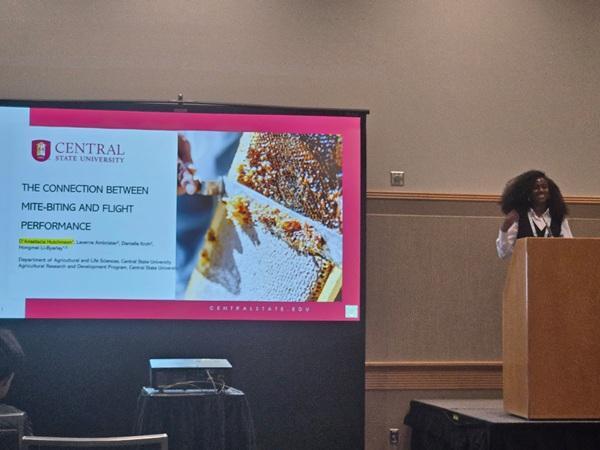
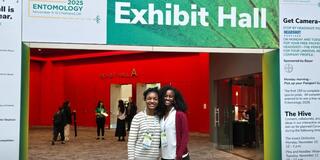
Two undergraduate researchers from Central State University’s Department of Agricultural and Life Sciences in the John W. Garland College of Engineering, Science, Technology, and Agriculture presented their work at the Entomological Society of America’s national conference in November in Portland, Ore. Their presentations highlighted innovative approaches to improving honey bee health and resilience—an increasingly urgent challenge facing agriculture nationwide.
D’Anastacia Hutchinson, a junior psychology and biology major and student researcher under Hongmei Li-Byarlay, Ph.D., research associate professor of entomology, delivered an oral presentation examining how honey bees’ defensive behavior against Varroa destructor mites relates to flight performance. Varroa mites are among the most destructive parasites affecting honey bees worldwide, weakening colonies and reducing pollination capacity.
Hutchinson analyzed more than 2,200 mites collected during summer 2024 to determine how many exhibited missing legs—a marker of the bees’ “mite-biting” resistance trait. Colonies were then evaluated using a flight mill to compare endurance and distance between bees with high mite-biting ability and those with lower resistance.
“These students are addressing nationally significant issues affecting honey bee health,” Li-Byarlay said. “Their findings will help improve colony survival and pollination efficiency, and it is exciting to see emerging scientists from Central State contributing to this effort.”
Hutchinson’s research explores an often-overlooked question: whether colonies that aggressively remove mites also demonstrate enhanced flight performance. If confirmed, this trait could have broader implications for pollination efficiency and agricultural productivity, offering new insights into how natural mite resistance supports healthier honey bee populations.
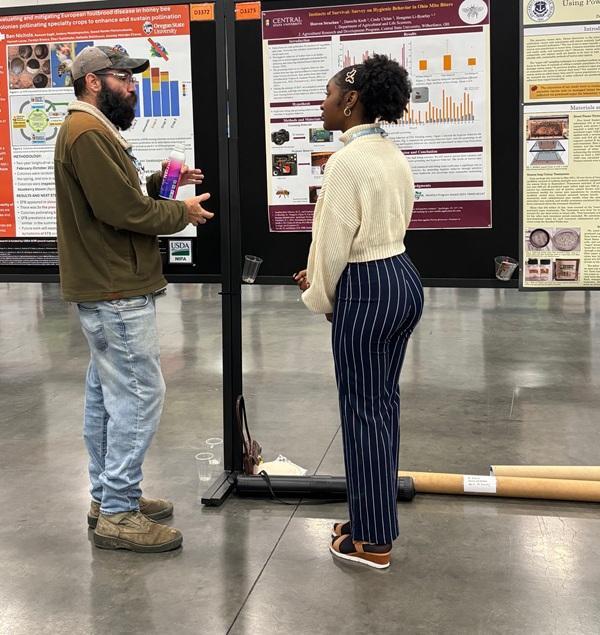
A second CSU student presenter, Heaven Strachan, a junior sustainable agriculture major, investigated whether Ohio honey bees with high mite-biting ability also exhibit strong hygienic behavior—an essential colony defense mechanism in which worker bees remove diseased or dead brood.
Strachan’s research uses the Universal Bee/Odor (UBO) assay to measure hygienic behavior across a diverse set of colonies, including commercial, Russian, and feral bees. By comparing hygienic behavior results with known mite-biting levels, her study seeks to determine whether the two traits are correlated. A strong correlation could simplify selective breeding efforts, reduce reliance on chemical treatments, and improve colony resilience through natural defenses.
Both student presentations reflect the growing research profile of Central State University in pollinator genomics and honey bee behavior. Their work advances understanding of natural resistance traits, supports sustainable breeding programs, and contributes to the long-term health of agricultural ecosystems.
The Entomology 2025 conference brought together an estimated 3,000 researchers, educators, students, industry professionals, and policymakers from across the country to share research that impacts agriculture, food security, and environmental sustainability.
As honey bee populations continue to face threats from parasites, pathogens, and environmental stressors, research conducted by CSU students is helping identify real-world solutions that protect pollinators and strengthen American agriculture.
CSU’s bee research laboratory has sponsored six undergraduate students and three postdoctoral researchers to present at Entomological Society of America conferences over the past eight years.