Image
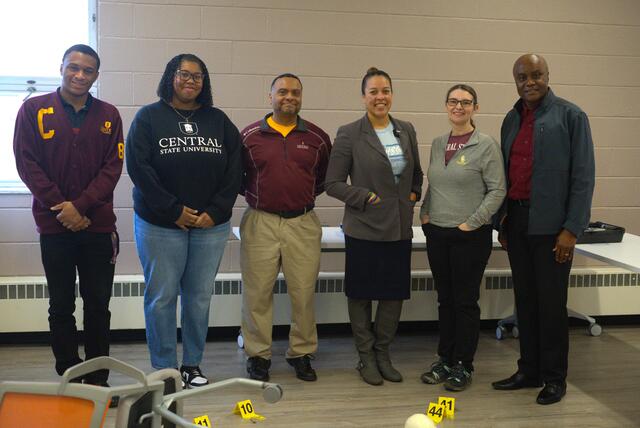

Central State University’s Interdisciplinary Forensic Studies minor received national attention on Monday, November 24th as Dr. Erin Lynch, host of WeHBSeeU TV on the QEM Network, visited campus to interview undergraduate researchers and faculty members whose work bridges the social sciences and chemistry.
Lynch and her documentary film crew spent the day filming students and professors for an upcoming episode of Forensic Files, a WeHBSeeU TV series highlighting how Historically Black Colleges and Universities are preparing the next generation of forensic scientists and researchers.
Students demonstrate forensic methods through mock crime scene
As part of the visit, students constructed and presented a mock crime scene designed to illustrate the step-by-step processes used in forensic investigations, from initial documentation to evidence collection and analysis.
Students walked the film crew through standard procedures, including scene security, photography, sketching, fingerprinting and the handling of physical and biological evidence. Faculty members explained how these hands-on exercises mirror professional forensic protocols and reinforce classroom instruction.
The mock crime scene allowed students to demonstrate how interdisciplinary training — blending social sciences with chemistry and laboratory analysis — is applied in real-world investigative contexts. The exercise was featured as part of the documentary filming and highlighted the program’s emphasis on experiential learning.
For senior Aniyah Cavitt, a sociology and psychology double major with a forensic studies minor, participating in the documentary offered an opportunity to share the program’s growing impact.
“It felt very rewarding,” Cavitt said. “I’m so glad that I got to speak about something that is continuing to build as the semesters go by. I just hope that it gets students interested.” After graduation, Cavitt plans to apply for forensic positions at all three Bureau of Criminal Investigation offices in Ohio.
Faculty members noted that the mock crime scene mirrors professional standards and protocols used in the field, preparing students for graduate study and careers in forensic science, crime scene investigation and laboratory analysis.
Chemistry professors Dr. Suzanne Seleem and Dr. Leanne Petry emphasized how the program connects scientific principles with real-world justice applications.
“Our students value the opportunity to see how chemical principles are used to analyze evidence and contribute to justice,” Petry said. “They begin to understand how science, communication and ethics intersect within the legal system.”
Seleem said many students are motivated by lived experiences in their communities and a desire to pursue justice.
“They see themselves as tools to establish justice through knowledge,” Seleem said. “That sense of purpose fuels their passion.”
Program origins rooted in collaboration
The forensic studies minor was launched during the 2023–24 academic year with support from a nearly $400,000 National Science Foundation HBCU Undergraduate Program grant.
“This program was created to expand how people think about forensics,” said Dr. Genevieve Ritchie-Ewing, associate professor of sociology and anthropology at Central State and one of the program’s founders. “Rather than focusing only on laboratory science, we intentionally built an interdisciplinary minor that brings together psychology, social work, anthropology and chemistry.”
Ritchie-Ewing said the grant enabled the university to enhance coursework by acquiring professional-grade tools and materials used in crime scene analysis, forensic science and forensic anthropology.
Podcast conversation amplifies faculty, student and national perspectives
The campus visit and documentary filming were discussed in depth on the Central State University Podcast, hosted by Dr. Cyril Ibe, CSU Land-Grant interim communications coordinator, who interviewed Lynch, faculty members, and program leaders.
Ibe guided conversations exploring the program’s growth, student outcomes and broader societal impact, providing listeners with insight into how the interdisciplinary minor is shaping academic and professional pathways at Central State.
Through the podcast, Lynch praised CSU students for their preparation and professionalism.
“They were meticulous and confident, and they could clearly explain why they do things a certain way,” Lynch said. “That tells me they are not only well trained but prepared to be professionals in this space.”
Broader impact and national visibility for HBCUs
Since its launch, the forensic studies minor has enrolled more than 20 students and graduated four in its first year, a strong showing for a small institution. Student interest continues to grow, with graduates pursuing careers and advanced study in forensic science, psychology, social work and criminal investigation.
Senior Jonathan Foster, a sociology and criminal justice double major with a forensic studies minor, said the national exposure provided by the documentary could inspire future student stating that the program’s emphasis on hands-on learning sets it apart.
“This isn’t just something I’m reading in textbooks,” he said. “I can actually look at a bone, look at evidence and process it with my actual hands and have a clear understanding of what it is. It’s a hands-on experience offered here at the illustrious Central State University.”
Later in the day the film crew met with University President, Dr. Morakinyo Kuti to discuss the importance and relevance of research at Central State and the investment we are making in our faculty, students and facilities to grow and expand our programs.
During the conversation, President Kuti highlighted Central State’s commitment to expanding research capacity across disciplines, noting that investments in academic programs, infrastructure and experiential learning opportunities are central to preparing students for graduate study and the workforce. He emphasized that these efforts support the university’s broader goal of advancing toward Carnegie Research II (R2) classification, a Carnegie designation recognizing high levels of research activity.
“HBCUs are doing groundbreaking science that deserves national visibility,” Lynch said. “What Central State is doing here has implications not just for this region, but for the country.”
Lynch said Central State’s program will be featured alongside other HBCUs in the Forensic Files documentary series, which is expected to stream on WeHBSeeU TV. The platform is available on Roku, Apple TV and mobile applications.